
On October 23, 2025, the U.S. Department of Justice (“DOJ”) announced the indictments of more than 30 people allegedly involved in a widespread NBA gambling scheme. Among the defendants are prominent figures in the league, including Terry Rozier, who played for the Charlotte Hornets at the time of his alleged criminal conduct. The indictment alleges that, prior to a March 23, 2023 game against the New Orleans Pelicans, Rozier shared information with a co-conspirator that he would exit the game early due to an injury that was not publicly known, resulting in fraudulently obtained winnings from bets placed on Rozier’s performance.
As the dust settles around the DOJ’s announcement, questions have been raised about the NBA’s handling of Rozier, whose early exit from the Pelicans game was flagged for the league as suspicious back in 2023. In the spring of 2023, the NBA conducted an investigation into Rozier’s conduct and took no action. Sports journalist Pablo Torre reported on his podcast, Pablo Torre Finds Out, that the NBA’s investigation of Rozier was “never closed, so he was not cleared of anything. Us not being able to find something is not the same as cleared.” Torre’s comment assumes the process might have resulted in a declaration of innocence had Rozier actually been free of fault. This assumption fundamentally misunderstands the workplace investigation process.
Workplace investigations, whether conducted by internal or external investigators, are civil processes and, as such, apply an evidentiary standard known as the preponderance of the evidence. The preponderance of the evidence is equivalent to saying it is more likely than not that something happened, and the burden of proof lies with the complainant to prove a respondent’s fault. In other words, to meet a preponderance of the evidence standard, there must be at least a 50.1% chance that something nefarious happened. The scales must tip, ever so slightly, in the direction of wrongdoing for a substantiated finding. If they tip in the other direction, or there’s only a 50% or less chance that misconduct occurred, the preponderance standard has not been met. According to the NBA, that is what happened in relation to its investigation of Rozier.
Unlike a workplace investigation, an indictment is a criminal matter involving a different process, investigator, and standard of evidentiary proof. The indictment itself is a document accusing a defendant of engaging in certain unlawful conduct, and it is issued by a grand jury. In deciding whether to issue an indictment, a grand jury hears evidence presented to it by the U.S. Attorney’s Office—prosecutors. A prosecutor is not an impartial investigator. The prosecutor’s job is to obtain an indictment and, ultimately, a conviction. Defendants and their attorneys are not present in grand jury proceedings, so the evidentiary presentations are entirely one-sided by the people hoping to convict the defendants. This is remarkably different than the workplace investigation, which is ideally conducted by an impartial investigator with no stake in the outcome of the investigation.
Another important difference between the workplace investigation and the grand jury proceeding, as it relates to Rozier, is the applicable evidentiary standard. To issue an indictment, a grand jury must find probable cause that a crime was committed. Probable cause is a lower evidentiary standard than the preponderance of the evidence. Eventually, if Rozier does not plead guilty, prosecutors must show a jury at trial that Rozier is guilty beyond a reasonable doubt, which is the highest evidentiary standard in the American legal system.
Evidentiary Standards of Proof As they Relate to Rozier
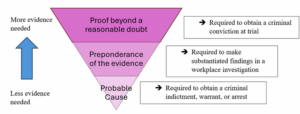
These are not the only evidentiary standards in the American legal system, however they are the ones most relevant to Rozier’s case.
There is one similarity between the two processes that might disappoint Pablo Torre, however. The burden of proof in both lies with the accuser to prove Rozier’s guilt. It is not up to Rozier to prove his innocence, and expecting an outcome that definitively declares his lack of culpability with confidence distorts the process.
While the questions around the NBA’s lack of action are understandable in light of the DOJ’s announcement, there are several things to keep in mind about these different processes.
- The NBA’s investigation applied a higher evidentiary standard than the DOJ has had to meet thus far in the criminal process, and that higher threshold was not met.
- The grand jury proceedings involved a one-sided presentation of evidence by people whose job it is to get a specific outcome, not an impartial actor. (This is why a prosecutor can “indict a ham sandwich,” as the saying goes.)
- The DOJ’s investigative muscle is substantially stronger than what private workplace investigators can do. Not only can the DOJ subpoena evidentiary records workplace investigators may not be able to access, it can also threaten criminal charges and obtain witness statements or future testimony in exchange for plea deals or immunity from prosecution.
In sum, we don’t know what evidence the FBI has uncovered regarding Rozier, and it is certainly possible that prosecutors can eventually meet their very high burden to prove Rozier’s guilt beyond a reasonable doubt. However, they have not yet done so. The fact that the NBA’s investigation did not result in substantiated findings says less about the efficacy of its internal investigation than it does about the different processes, tools, and standards applicable in the private civil and criminal settings.
Sources:
https://d3i6fh83elv35t.cloudfront.net/static/2025/10/u.s._v._eric_earnest_indictment.pdf
https://www.nytimes.com/live/2025/10/23/nyregion/nba-illegal-gambling-arrests